Tuesday, June 12, 2007

Live, from Stockholm, Sweden!


Says Libby:

So! We're at the Central Station in Stockholm, Sweden and will be leaving tonight (in half an hour!) on a night train to Boden which arrives at noon tomorrow. From there, it's just one more 7 hour train to Narvik, Norway ; the northernmost point served by the European rail system, and situated at 68 degrees north, even further north than Iceland! We'll arrive in Narvik at 7 pm on Wednesday, but from what we can tell, it will never get dark that night! Then the next day we have our fingers crossed that there's a bus down at the border between Sweden and Finland, because no one at the train station has been confident enough to confirm this in definitive language - they all say they "think so"... from the north border of Sweden and Finland we'll train down to Helsinki, the capital, where we're hoping to "couchsurf" with some gracious host before taking a long-ass ferry across the water back to Stockholm and eventually making it inland to Kulturstationen, our woofing spot. [click here for a general map of our itinerary]

To fill folks in on our last 36 hours....

After we left Bente and Soren's delightful place in Fano, we hopped on the "train" - another bus, due to the travel-prohibitive expansion of the rails from the heat, and bussed-trained through Kopenhagen across the islands to Sweden, where we were delighted to be hosted in Lund by a dear friend of mine from the International House days at UCSD, Nik. Nik met us at the station and treated us to a tasty dinner at an Italian place. The three of us talked about the political system and the positive and negative aspects of the European Union. European farmers, for example, receive 1/3 of the money of the EU to subsidize their crops, and continually overproduce. The surplus is dumped onto the African market so that prices stay higher for the farmers in Europe (the US is culpable of the same), the value of the African goods is greatly reduced, and this is one more reason why African agriculture can't compete on the world market (not even considering access to technology, disparate growing conditions, or hundreds of years of colonial exploitation, etc.) Despite some of its flaws, Nik was keen to point out that the greatest benefit of the EU is the solidarity bred among the citizens of the continent and the assurance that Europe won't again see a continental war like befell them with WWI and II. As we strolled back in the cool summer twilight to Nik's place in the student dormitories, we mused about effective tactics for social change. Many folks had moved out of the dorms for the summer so we had our own luxurious dorm room! It was great to see Nik and we're hoping to reunite with him next month when our trajectories collide in Montpelier, France.

As we left Lund this morning, there were a bunch of drunk Swedish high school graduates in special sailor hats (apparently a Swedish graduation tradition), blowing whistles, singing, and trumpeting through the streets this morning to celebrate their graduation. Slightly obnoxious, slightly entertaining.

Once we arrived to Stockholm, we stuck our heavier bag in a locker and explored Stockholm for the afternoon. The buildings here are tremendously well-kept, the facades intact and most of them having really interesting architectural design with fancy domed black roofs, turrets, balconies, etc. There seemed to be an abundance of trees and parks mixed in with the busy city, and it has a very international and multicultural feel having recently left the sheltered island of Fano (Thai food for lunch, hurrah!).


We've got tons of photos to upload, but unfortunately this netcafe won't allow us to connect the camera, so they'll have to wait until next time, probably this weekend. Sorry for the lag in postings, and we look forward to being able to relay the experience of life in the land of the midnight sun and other Scandinavian adventures!

Much love from Libby and Billy

Learning about Denmark on Fanö island

Billy says:

We spent a weekend in roughly idyllic conditions, visiting libby's cousins bente and soren on the island of fanö, off the west coast of denmark. We were housed in our own little cottage, given bikes to travel about, and fed scrumpuous meals everyday. Bente had asked us to bring some warm weather, and we brought unusually warm days indeed, with 30 degrees celsius full sun till 11pm. Still, we enjoyed running around the yard with their dog sisse - playing "tug of war" with her rope - walking, (and, for libby, running) along the beach, (where the yearly two week long kite festival with dozens and dozens of kites, was underway) and biking the 10km length of the island down to the small town of sonderhö for a few scoops of ice cream.


Despite Soren being shy with his english, Bente kept lively conversation going the whole time (and translated for Soren as well). She is a very attentive listener, fully and genuinely engaged, curious, and delighted to share. We had silly times, like when we made casual bets on the "speedway" motorbike races on TV, trying to solve Danish kids' word puzzles, and trying out incredibly hard to pronounce and giggle-producing Danish phrases. But we also had many important, serious talks.

Bente was very interested in us learning about the Danish political and social system, and she's a good teacher. Bente was raised by a social-democratic family and is still proud to be participating in a society that intends to care for the health and happiness of its members. She sees it as important that workers join unions and play an active role, thinks anyone that wants a bed to sleep in ought to have one, and is compassionate enough to realize that working doesn't make everyone happy. Personally, since both her and soren have slight disabilities, they are eligible for the "flexi" work program in Denmark. As such, they both work roughly 20 hrs per week, and, with funding from the state, are paid a full week's wages. She is quite grateful for this program because, in her 40s, she doesn't feel ready to retire and feels quite useful in her job at county hall. This is only one of many excellent provisions and rights within the Danish system, such as: all students in university receive a monthly living stipend, childcare is subsidized 75% or more, children 9 and older are heard in court regarding their parents' divorce (and at 12 their opinion is given full weight), and - as if it's cliche to say so - every aspect of health care - from the midwife to the nursing home, is totally free.

Bente doesn't feel that these values are being eroded in Denmark, but she wasn't too proud to note the down sides, such the recent election of a neo-liberal president and Denmark's role in West Indies slave-trading during colonial days. In short, her version of socialism is quiet, simple, genuine, and open to modification.

***

from left to right: libby, sisse, bente, soren and mette, soren's daughter, in front of their house:

some extra photos:


the train across the german-danish border was only one car long, sort of like a bus. it had to honk and slow down at lots of little farm intersections!

soon there will be photos and stories about: G8 Blockades! here

says Libby:
Hello! We don't have time to write/post all of our stories at once, so this is a teaser. Soon there will be stories and photos here about more of our experience in Rostock at the G8 summit, creating a blockade of the roads 10,000 strong to disrupt the smoothness of the summit. Some of the things you can look forward to reading about are: staying the night at the Indy Media Center, couchsurfing with a delightful German woman named Charlene, and marching through fields by the thousands to avoid police barricades en route to the creation of our grand human blockade. Also, ideological factions amongst protesters, police intimidation tactics, and, lest we get discouraged, humans helping each other meet their basic needs. I promise I'll do some work on this on the 50 hours of training (as in, trainRIDE-ing) we'll do this week so that it's a snap to post when we get back from the North Pole. Humor us by coming back to read this later, eh mateys?
cheers!

Tourists of sorts in Berlin

Says Billy:


Berlin was a joy to visit. Aside from everyone speaking German all the time, Libby and I were ready to move in. The "Futurist" in me (i don´t know what this means, but Libby likes to call me one) loves the highly organized, efficient and easy to use train and subway system (and though we bought a day pass on our first day in town, we used the subway dozens of times and never saw any need to have a ticket).

The anti-G8 organizers decided to disperse the international visitors throughout the squats and radical collectives centralized in the Kreuzberg neighborhood. Enjoyably to us, the cold war division of Berlin into four quadrants means that there´s no real "downtown," but rather lots of distinct neighborhoods with their own cultural and commercial districts. Kreuzberg is a pleasant mix of Turkish and African immigrants and young vegetarian and leftist leaning Germans. As activist "ghettoes" go, Kreuzberg felt much more "integrated" with the "locals" than other cities, and the organizers tried to strengthen this connection by printing 5,000 anti-G8 newspapers and distributing them door-to-door throughout the neighborhood and having Volkes Kuche (People's Kitchen) in Gorlitzer park.

Gorlitzer park is a likably run-down place, about 12 blocks long and 2 wide, with a nice stone path running through the whole length and then across the river and further on into the old East Germany (right across the river we stumbled upon an artsy/anarchisty squat neighborhood of vagens, with a couple dozen campers and a huge social/theatre space, all tucked underneath the bridge and running along the river). The whole park feels (to be dainty) "under manicured" and across from the people's kitchen is a huge fountain that apparently was built with the wrong kind of stone and so it froze and cracked horribly. As a result, it looks like bombed out ruins. This adds to the general worn down look of the park. But all the same, the park was full of people, no matter what time of day we went, and there seemed to be a relatively contented mix of muslim women chatting together, young hipsters having picnics and groups of punks drinking beer. It was a good place to have a free meal and have a meeting about protesting the G8.

We got set up with an awesome place to stay. An apartment with 7 anarchists living together, right by the health food store and U-Bahn. We had our own room with Loft bed and were welcomed to leave our things and go off to Rostock for days. All the housemates we met were kind, hospitable and thoughtful radicals. Really, we talked about moving in!

On our last night in Berlin, we made a huge meal and sat and talked with three of the housemates. One was raised in a small town in East Germany and one was raised in East Berlin. Both were teenagers when the wall fell. So, we asked them to tell us about the "good side"* of life in East Germany. I know that I'm at such a disadvantage in trying to really understand communism or the cold war. I think the so-called "iron curtain" was so thick and full of thorns that it'll be incredibly difficult to tear it down now. So, I'm really grateful for the stories and descriptions our friends from Berlin gave.

In short, they told of a profound contradiction, or paradox. In East Germany, they had, "no political freedom," "everything was totally ordered - our whole lives were planned out," and, basically, "it was totally boring." "We lived in identical grey concrete boxes and just worked. Everyone who didn't want to work was punished for 'anti-social behavior'... then, suddenly, at 65, you didn't have to work and you were free to travel." At the same time, "food was really cheap," "rent was cheap," "books were cheap," "the cinema was cheap" "everyone was guaranteed housing and healthcare was free," and to top it off, "our schools were better than those in the West; we were all highly educated, with a high emphasis on literature, culture." In other words, meeting all of people´s basic needs is not enough. People crave - maybe need - autonomy, joy, play, even unpredictability.

Our friend from the small town in East Germany seemed stubbornly devoted to doing whatever he wants, whenever he wants. One housemate said that he sometimes goes weeks by himself and then suddenly rejoins the community. This seems a natural reaction to a highly organized existence. Still, he says he wants "No Government, but when a hospital needs built, I want someone to build it."


It's simple-minded and self-serving to say that communism is all bad and claim a victory for capitalism, but this is what has happened since the wall fell. There was some small discussion about "taking the best of both Germanys" but this was way less popular than simply scolding the communists and flaunting all the new commodities. Seems so much better to just face it, talk it out, analyse it, try and understand what communism really meant for people living "under" it. There's a lot to reject, even hate, and certainly laugh at, but it's so pitiful and horrible to deny, to pretend, to lie.

* We had gone on a "free" (because they don´t pay their staff anything, so they survive off of tips) bike tour earlier in the day, which had some highlights, but was disturbingly full of pro-capitalist propaganda - the same kind of nonsense my parents were fed when they were forced to hide under their desks because the Russians were about to bomb them to bits and somehow the desk would save them. We were told that millions of East Germans flocked to the West because the west had "Levi's and Coke" and in the east they only had "polyester pants and lemonade," and other such gems of wisdom. There were repeated references to how ugly the communist architecture was and how it was poorly built because the communists didn't have all the great wealth and technology that the west has.

Still, as tours go, it was mostly interesting, with lots of info. about the Berlin Wall and Nazism. Maybe my favorite thing was the "memorial to the murdered Jews of Europe," which was an intentionally vague field/grid of some 2700 grey concrete slabs of various heights (but same dimensions otherwise) right in the middle of the busiest area of Berlin.
I also really loved the memorial to the 20,000 books the Nazis burned in 1933. It was a whole bunch of empty shelves, enough to hold 20,000 books, and it was underground, so you looked at through glass on the ground in a plaza. There was also a plaque there with the quote, "if you start by burning books, you'll end by burning bodies."

In all, Berlin is really intense. So much of the tour took me to places where horrible atrocities had happened, or really ugly attempts at war or totalitarianism. It was hard to know how to take it all seriously enough on this brief tour through the city with a bunch of ignorant and arrogant Americans.

Monday, June 4, 2007

Freedom of movement

Says Libby:
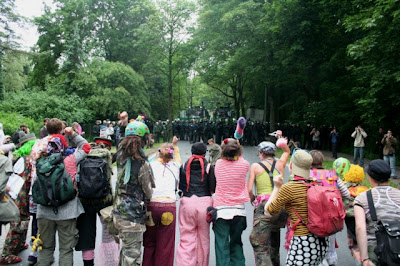
Today we attended a demonstration for freedom of movement, against the anti-immigration policies of the EU. We made some German friends quickly simply by asking where the demo was going to be when we got off the train station this morning - we'd decided to commute up for the day, but brought our sleeping bags in case something drew us to stay the night. We tagged along with our new friends through the streets of Rostock toward the meeting center for the demo. Every street was lined with police vans. Honestly there must have been hundreds. As the German Darth Vader storm troopers in full riot gear tromped behind us toward the same point, there was a little bit of an ominous feeling... until - what's this? Bells, whistles, and cacophony? We turned around to see a colorful clown brigade tooting their whistles, blowing bubbles, and marching behind the troops of polizei to the tune of "Left, right, left! Love and respect!" The 2 Storm Troopers at the end of the line marched backwards, half tripping in the awkwardness of facing the wrong way, but making sure the dangerous clowns didn't use their bubble guns on any of the cops. (Actually, later, I watched a sad clown get the water dumped out of her toy water gun).
[below, clowns hold off the (unnecessary) riot police]

Ironically, though we were demonstrating in support of freedom of movement, we weren't allowed to go anywhere for the first 2+ hours; the polizei surrounded the initial bulk of demonstrators and made folks choose whether to be in or out of the circle, which was comprised not only of the riot police, but also of the giant water gun tanks, pre-emptively pointed inward at the crowd (which was notedly made up more of the dread-locked flower children sorts than the autonome). Apparently this circling is also called "kettling" (sounds and feels a lot like "cattle-ing") - a common tactic of British cops, now adopted by this crew.
We remained at the periphery for those 2 hours, unsure if the situation would escalate and wanting to avoid being trapped in the center of the circle or having to have our documents checked. I guess the police were saying there were too many demonstrators or something... we heard many stories about why the procession wasn't going anywhere. Just imagine lots of waiting and standing around while the bright yellow vested folks of the Legal Team negotiated with the captains of the police forces. Finally, we were allowed to proceed, and we bumbled forward for a while, until again, the march was stopped. The news over the speakers was that the police were refusing to allow the march to proceed through the city center, and that a press conference was being held at the front of the line. Meanwhile, many took up dancing in the streets to the music being pumped from the trucks in the march, or playing games on the rail tracks beside the road. It had been grey and dark all day; finally, a little rain broke loose, and as Billy and I both needed a restroom and water, we decided to break away from the demo for a while to meet some of our needs.
Turns out we weren't the only ones. It seemed that the demo was dissolving from the tiredness of being repeatedly held up, and people were walking down the streets like us. We decided we'd go catch the local rail back to the train station to return to Berlin for the night. But alas, after some time waiting at the station, an announcement was made that no trains were running between the area of the demonstration and the main Hauptbahnof station, where we needed to catch the train to Berlin in about 15 minutes. Feeling a little defeated by the long walk that awaited us, we walked back to the street we'd come from, only to find the the march had somehow gone on. All the folks who'd intended to catch a train returned to the street with a little renewed vigor as the music blasted and the die-hards who'd stuck it out carried on. We joined in of curiousity, thinking perhaps we'd gain a little ground to get closer to the station, and the crowd picked up more and more energy and it became apparent that several sects of folks who'd broken off were reuniting as independent smaller marches back into one large one, coming in from other streets, to the cheers of all. Rave music pumped everyone up as we half marched, half danced our way back toward the harbor, with old folks and little kids looking out their windows. It seemed like perhaps there were even more demonstrators than when we first began the march! By the time we passed by the independent media center, Billy and I were exhausted and still hadn't found a toilet, so we dropped out of the brigade and came here, where we've had computer access and also some warm food from the völksküche - "Peoples' Kitchen".
And what of it all? All of this is so up and down, push and pull. It's hard in the face of the militarized forces to feel like we're even making a dent. When one police team gets tired, they get sent back to their vans to rest, eat, and have a smoke. If they're thirsty, water is brought to them. We have no place to go but stand, encircled, in the misty drizzle. And yet, there is an unmistakeable energy to all these folks coming together. One of the oft-spoken themes of the demonstration, "another world is possible", while totally cheesy, provides some of us with the reminder to imagine what we want and further, to take steps toward creating it. How to do so in the face of such a monstruous, seemingly unstoppable, well-oiled, well-funded, and well-armed machine? I don't know. At the School for Designing a Society we defined a system as " a collection of components such that any change of state in one of the components alters the state of the whole". It's useful in rhetoric to label the "system" as something I am not a part of, so that I can more wholly reject those aspects of it I find horriying, enraging, saddening, detach myself from any responsibility for the atrocities we propogate knowing-and-unknowingly. But it also seems useful to view myself as one of the components of the system, such that a change in my energy alters the momentum of the whole. Maybe that's overly optimistic and naive. I'll still decide to believe it as long as I can. Both Billy and I felt it important for people of European descent to be a loud presence in solidarity with those non-europeans who are denied equal rights under immigration laws, and though we are quite tired from the waiting around and walking all over the city, I don't think either of us regret coming. There is a certain welling up of ecstatic joy to be dancing erraticly in the streets in defiance of the devaluation of human life and happiness. And that glimpse of something beautiful is enough to keep me going, at least until tomorrow.

ONLINE UPDATES

Two spots to check up on the G8 action:
G8-TV

Indymedia ticker

We are safe and enjoying ourselves, though tired of standing in lines against cops and for food.

oonz, hee, internazionale solidarite!

Sunday, June 3, 2007

Autonomes and Other Disturbances

Says Billy:
Yesterday we went to Rostock for the large, anti-G8 demonstration there. This was the first of the week of any large numbers, and clearly planned to be a huge "everybody left of center" type ordeal, complete with trucks blasting political rhetoric and music, vendors and porta-potties galore, and hours and hours of speeches and music planned for the end. It was a huge array of mostly far-left folks, but a good sprinkling of unionists, peaceniks and environmentalists, anti-poverty reformers, etc. We walked some 3 or 4 kilometers before reaching the harbour area.
Spread out for hundreds of metres along the sea, some 50,000+ folks were supposed to stand in long lines for food, drink and toilet and listen to "uplifting" chatter about our bold stances in response to the G8. Meanwhile, the polizei had an occasion to exercise their elaborate "security concept" that has been underway for many months. They stationed some 50 vanloads of police throughout the town, and another half dozen huge attack vehicles - tanks, armored trucks and a huge water cannon truck. Meanwhile, one of the largest groups of Black Blocs i´ve ever seen (police and BBC estimate some 2,000 black-clad militants, marching row after row) have a chance to push the limits of allowable activity. In germany, these folks are known as the "autonome," or autonomous protestors. They have a reputation for "simply destroying," which is perhaps not so different from the anarchist reputation in the US, except likely worse. They are always upsetting liberals.
After a couple of hours of rather tedious, and sporadic, back and forths between the police and protestors (police charging through the crowd in a huge display of nastiness, being pushed back by stones and sticks and occasional fire and then back again to the same starting point), things turn decidedly more violent. At a certain point, the police "retreated," in order to shoot the first dose of tear gas into the crowd. In the power vacuum that followed, the autonome set fire to a couple of cars, sending black smoke hundreds of feet into the air and visible throughout town. Police responded with a series of punishing attacks, sending wave after wave of riot police (dressed in various colors and with various gear) into the crowd, making great fascistic gestures like thrusting their batons in the air in unison, shooting cloud after cloud of tear gas, and eventually dowsing the entire crowd in huge bursts of water from their water cannon truck and pushing everyone back with their tanks and armored cars.
In general, the upset liberals will carry the day´s discourse. The media reports that the "security concept" is correct, because the autonome are so violent. Ludicrous numbers of injured police are broadcast publicly, and likewise the list of damaged property is pumped with steroids. The violence of the anarchists will "legitimize" future repression of this weeks´ scheduled protests.
Ok, so they will say what they like.
Let me attempt to draw a few strategic conclusions/lessons from the day.
First, let´s remember a few things about the "legitimacy" of violence and repression. Both sides can "legitimize" their actions in any way that they like, at any point. The police can and do come up with all sorts of reasons to prove themselves as necessary, but essentially everything the police do is based on the basic idea that the state has the right to a monopoly on violence, which is not to be questioned. And the water cannons that attacked protestors were in place long before any violence "legitimized" their presence (and weren´t used to put out the fire, let´s remember!). On the other hand, the autonome can "legitimize" violence based on the death of Carlo Guiliani or even Fred Hampton, for as far as actions taken are "legitimized" by anything at all.
Second, it´s important to note that no protest with such a mixed set of goals is likely to go well. If some organizers and some thousands of participants wanted a festival by the sea with music and vendors and such and some 2,000 more wanted confrontation, both sides were likely to be frustrated. Furthermore, if the autonome really wanted destruction, they might have done better moving away from the harbor and towards places (even outside rostock) where hundreds and hundreds of riot police were not concentrated.
Lastly, it is clear that anyone attending a demonstration at this point needs to be both informed in advance about what they are getting involved in and thoughtful constantly in the moment. All protests move extremely quickly from one dynamic to the next, and it is certainly the peace-loving white woman in her 40s with a split head that is the saddest sight for all involved.